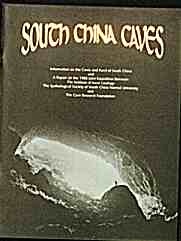
Rondal R. Bridgeman and Karen B. Lindsley. 1991. 25 b/w photos, 20 maps and illustrations. 62 pp. 81/2 x 11 South China Caves is a very informative and well-illustrated report on the March 1988, joint expedition of the Institute of Karst Geology, the Speleologi- cal Society of South China Normal University, and the Cave Research Founda- tion. This report focuses on the high karst plateau in northern Guangdong Prov- ince, the slope mountain karst within southern Hunan Province, and the mature tower karst area in Guangxi Province of southern China. These areas are rich in caves and have the potential to contain the deepest caves in the world. An overview of the geology of these areas is included along with chapters that cover speleothems, cave fauna, cave management and conservation, karst management, and the background of modern Chinese speleology. Readers will also enjoy Michael Ray Taylor's light-hearted excerpts from his surface diary of the people and places of this area.
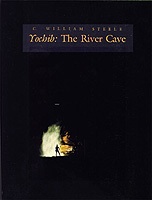
C. William Steele. 1985. 41 b/w photos, 15 drawings, 8 maps. 164 pp. 73/4 x 101/4 This is the gripping account of the history and exploration of Mexico's most dangerous and challenging river cave, Sumidero Yochib, located beneath a re- mote valley in the highlands of Chiapas, southern Mexico. The exploration took place from the spring of 1974 through the spring of 1977, and was possible only during a few dry months each winter and spring. It is the story of the almost unbelievable exploits of Steele and his companions while they explored a cave prone to frequent flooding that contains almost two dozen sheer drops as much as forty-five meters deep. Well-drafted maps in each chapter guide the reader through the action taking place, whether it is the near drowning of team members, the horror of being trapped in a flooded cave, or the thrill of being the first one down a waterfall. "It is a precious slice out of speleological history." --Bill Stone, coauthor of Beyond the Deep: The Deadly Descent into the World's Most Treacherous Cave
By Herbert Daniel Gebauer. 430 p., countless maps and cave surveys; Berlin 2012. BHB publications 47 & 48. The "bible" on karst and caves of the East Khasi Hills and the Ri Bhoi district in Meghalaya/India. Alphabetical cave directory of far over 700 caves descriptions. Longest cave is Krem Mawkyhrdop (Mawmluh) at 7.2 km. An incredible source for future expe-ditions as many caves in the East Khasi Hills are still unsurveyed. Vol. 47 has 210 pages and contains the introduction, geological settings, thorough area descriptions as well as the 1st part of cave registry. Vol. 48 provides, on 220 pages, the 2nd part of the registry, cave lists, maps, and references. In English.
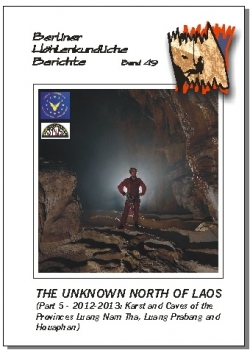
J. Dreybrodt & M. Laumanns (Eds.): The Unknown North of Laos. (Part 5 - 2012-2013: Karst and Caves of the Provinces Luang Nam Tha, Luang Prabang and Houaphan). - 150 pp., colour photo tables, many maps & surveys; Berlin 2013. This volume presents the results of the 2012 and 2013 International Expeditions to Northern Laos and describes a total of 27 km of passages from 95 caves, all of which are represented by a detailed survey. Includes Tham Doun Mai (3,745 m) and Tham Nam Oogh (3,140 m). In English with German and French abstracts.
S. F. M. Breitenbach & H. D. Gebauer: 199 pp., colour photo tables and maps, many surveys; Berlin 2013. This is our first anniversary volume! It has in-depth descriptions of over 350 cave/karst sites and also includes the historical surveys of the British expeditions in the 1940ties led by E.A.Glennie. Too many caves are unmapped yet. Consequently, this publication is a unique source for future explorers striving for improvements. In English language.
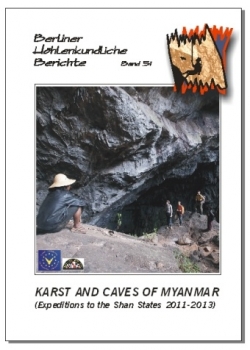
J. Dreybrodt & M. Laumanns (Eds.): 94 pp., colour photo tables, many maps & surveys; Berlin 2013. The follow-up volume of no. 39 in this series. Presents the results of 5 expeditions of the "Myanmar Cave Documentation Project" and describes 98 new cave/karst sites with a total of 17 km of new passages, exclusively from the Shan States. Includes the new longest cave of Myanmar (Kyauk Khaung at 4,790 m) as well as the new deepest cave (Mai Lone Kho at -160 m). In English with German and French abstracts.
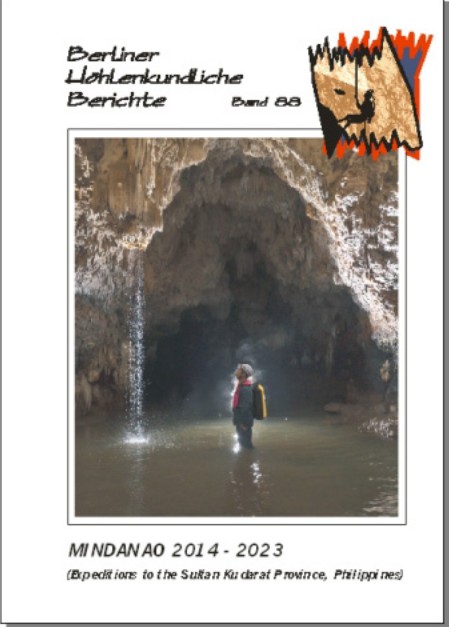
Nancy Pistole (Editor). 82 pp., many cave descriptions, cave surveys and maps; Berlin 2024. This volume summarizes the 2014-2023 expeditions of Philippine and US cavers to the Kulaman Plateau in Sultan Kudarat Povince, SW Mindanao). Thirty km of passages in 150 caves were documented, 56 cave maps were finished so far and are included in this volume.
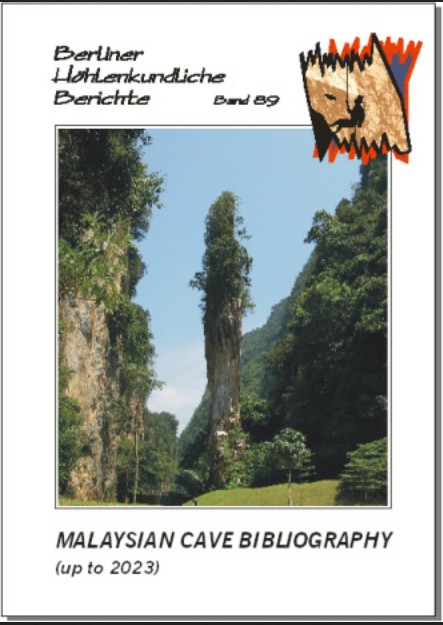
This bibliography covers the whole of Malaysia, i.e. Peninsula, Sabah and Sarawak, and contains almost 6200 entries on Malaysian caves and karst, dating from the 1700s to 2023. In addition there is an extensive newspaper biblio covering 1953–2023. Other pages provide an introduction to Malaysian caves and history, and there is a map and glossary. An invaluable reference work for anyone interested in limestone caves and karst, archaeology, conservation, flora and fauna, geomorphology, geology, hydrology, history etc., as well as for the sporting caver who wants to learn more about Malaysian caves.
89 pages, many cave maps and photos; Berlin 2026. Peter De Geest, Michal Hejna & Jos Beyens. This is an update to Volume 20 in this series, which described 28 caves with 22.7 km of passages. The present volume includes Belgian and Czech expeditions that have explored nearly 39 km of passages in 90 caves to date--including Giniba Cave, 13.5 km long, and Difshelei, 282 m deep. It features numerous cave maps and chapters on biospeleology, archaeology, and paleoclimate research. The text is in English with summaries in French, Arabic, Czech, and Flemish.
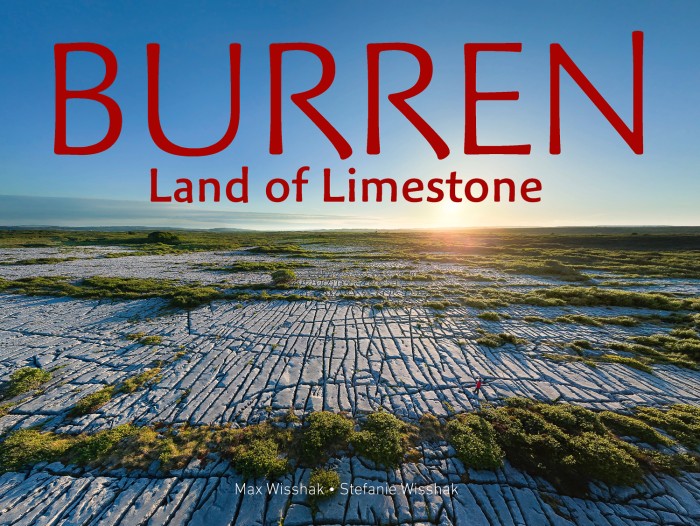
This coffee-table book showcases the captivating charm of an Irish karst landscape. In the Burren, limestone plays many roles, providing a unifying theme as we explore the area’s natural and cultural history, above and below ground.
On the windswept Atlantic coast of Ireland lies an intriguing landscape defined by sparse vegetation on bare limestone rock, smoothed by ice and sculpted by rain. This is the Burren, the heart of the Burren and Cliffs of Moher UNESCO Global Geopark. Its extraordinary glaciokarst terrain is home to an astonishing variety of plant and animal life, not to mention a rich geological and cultural heritage – all of which revolve around the limestone.
This book traces how rainwater shapes limestone pavements, how underground streams carve out caves that feed holy wells and ephemeral lakes, and how bare rock provides microclimates for archaic ferns and colourful orchids. It goes on to illuminate how communities used the stone beneath their feet to build megalithic tombs, cashels, tower houses, churches, and the vast network of drystone walls that climb the hills and support traditional farming practices in response to the harsh environment. Here, culture did not overwrite geology: it adapted to it.
Join us on a visual journey of discovery as we explore the Burren in all its facets, revealing the compelling beauty of this Land of Limestone.
Contents: Thirst in the Burren (poem) / Land of Limestone / Limestone Pavements / Wild Orchids / Archaic Fern / Sinkholes and Potholes / Caves and Underground Streams / Springs and Holy Wells / Loughs and Turloughs / Drystone Walls / Megalithic Tombs / Cashels and Castles / Churches and Graveyards / Behind the Scenes / Bibliography
Opening Poem: Moya Cannon
Author Bios:
Max Wisshak is a geoscientist in the field of marine research at the Senckenberg institute in Wilhelmshaven, Germany, and has published dozens of scientific articles and book contributions on this subject matter. Hi is also a passionate cave explorer, cave photographer, and publisher, who runs his own publishing label speleo-photo editions. Burren: Land of Limestone (2026) is his fourth premium coffee-table book on the subjects of and caves and karst, following Inside Mother Earth (2008), New Zealand Karst (2020), and Lechuguilla Cave (2022). His wife and coauthor Stefanie Wisshak is a geographer working as free-lance designer, writer, and text editor.
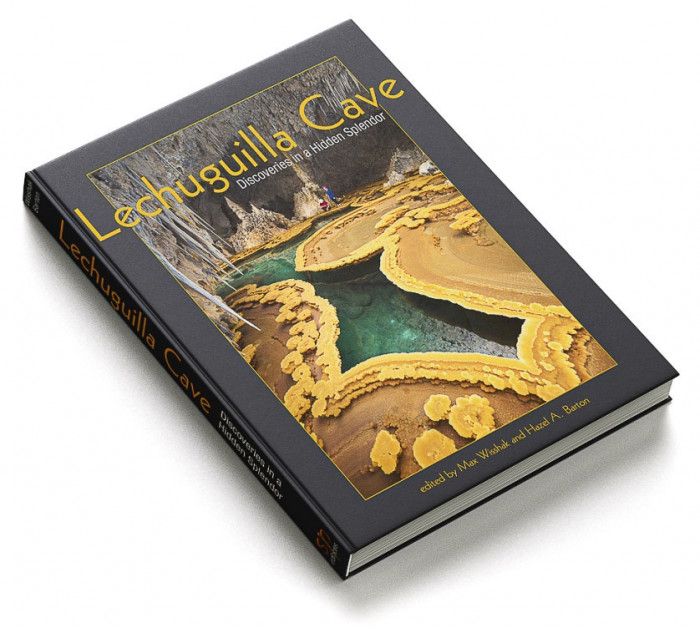
Lechuguilla Cave ( New Mexico, USA) is one of the most beautiful caves on Earth. Since its discovery in 1986, more than 240 kilometers of cave has been explored – with no end in sight. Owing to its geologic setting and unusual process of formation, the cave contains a remarkable diversity of rare minerals and formations, which have helped change our understanding of how caves form and the microbial life they can contain.
In this book, the most active explorers of the cave show the features that made it famous and reveal new discoveries in terms of beauty, scale, and science. Through their writing and photography, they take the reader on their journey of preparing for, and exploring, this remarkable cave. They describe how to successfully live and work in the underground, and highlight the challenges that must be overcome to discover and map new passages. An explanation of how the stunning imagery is captured takes the reader along in this visual journey of Discoveries in a Hidden Splendor. Finally, the extraordinary lengths undertaken to conserve Lechuguilla are illustrated, and how such efforts go hand-in-hand with exploration and photography to reveal the intriguing nature of this wonder of the underground.
Contents:Hidden Splendor (opening statement) / Fragile Beauty (foreword) / Greatness (foreword) / Beginnings (introduction and editors’ preface) / Discoveries / Speleogenesis / Speleothems / Water / Hidden Life / Preparation / Camp Life / Exploration / Mapping Mazes / Photographing Darkness / Rescue / Conservation / Best of the Best (closing remarks) / Fact Sheet / Bibliography / Contributors
Editors:Max Wisshak and Hazel A. Barton
Forewords and Afterword:Jonathan B. Jarvis, Rodney D. Horrocks, Peter Bosted, and Dale L. Pate
Text:Stan Allison, Andy Armstrong, Bonny Armstrong, Hazel A. Barton, Catherine H. Borer, Peter Bosted, Derek C. Bristol, Paul A. Burger, Beth Cortright, Jennifer Foote, Arthur J. Fortini, Donald G. Davis, Kevin Downey, Harvey R. DuChene, James F. Hunter, Daniel S. Jones, John T. M. Lyles, Aria A. Mildice, Arthur N. Palmer, Patricia E. Seiser, Jake Turin, Doug Warner, and Max Wisshak
Photos:Andy Armstrong, Bonny Armstrong, Daniel C. Austin, Hazel A. Barton, Peter Bosted, Derek C. Bristol, Dave E. Bunnell, Daniel Chailloux, Stephen Eginoire, Jennifer Foote, Kevin Downey, Rodolfo González, James F. Hunter, Brian K. Kendrick, Jean Krejca, John T. M. Lyles, Michel Renda, Robbie Shone, Rainer Straub, and Max Wisshak
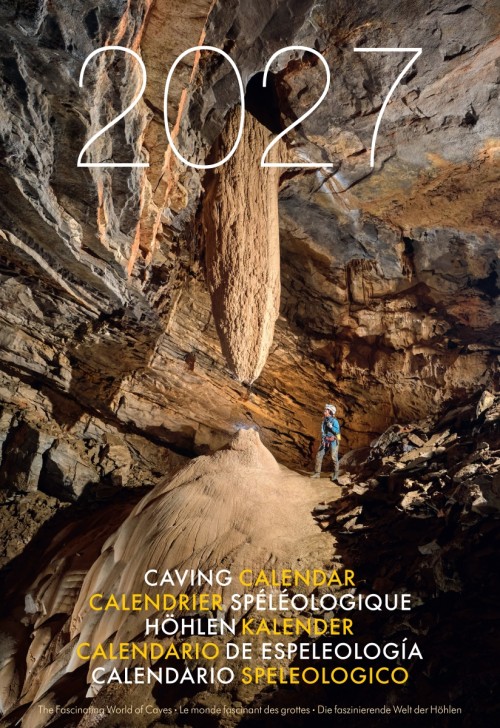
Speleo Projects features a selection of wild and touristic caves from around the world. The 12 monthly pages provide a glimpse into the caves of Ireland, France, Spain, Japan, Switzerland, Hungary, Slovenia, Vietnam and United States. All monthly pages with UV gloss varnish.