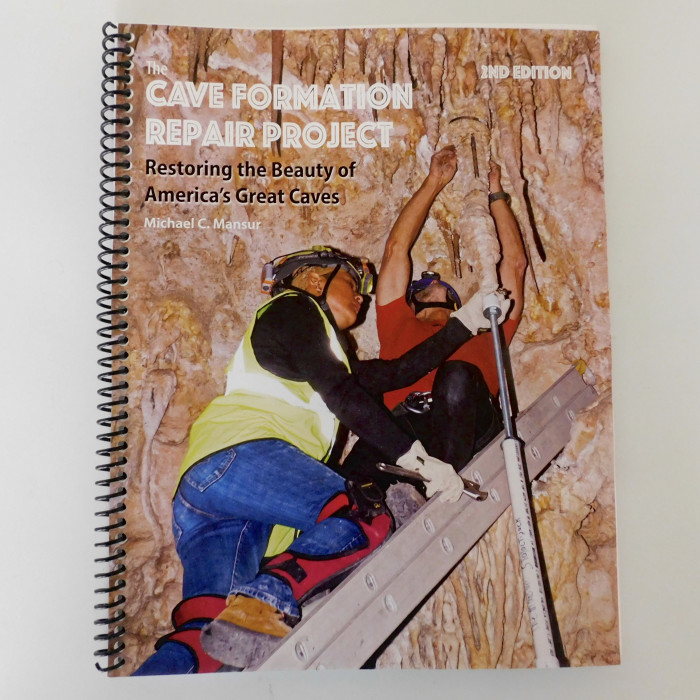
This second edition was published in May 2022, and is now available in spiral bound hard copy. 80 pp. An overview of the speleothem repair accomplished by the New Mexico-based, all-volunteer Cave Formation Repair Project from its inception in June 2018 through its third year. It also delivers step-by-step instructions for making and using the new repair tools and methods that are unique to this project. Project founder and author Mike Mansur strongly desires the techniques he and his volunteers have developed to be widely available to other cavers nationally and internationally so they might undertake formation repair work in their own local caves. In addition to informative text, each chapter features high-resolution photographs from work trips conducted by the Cave Formation Repair Project.
The author will donate $5.00, from each sale of this book to the NSS Cave Restoration Fund. The purpose of the Cave Restoration Fund is to support the repair of human-caused damage, both malicious and inadvertent. 62 pages. 2021.
The Cave Formation Repair Project: Restoring the Beauty of New Mexico’s Greatest Caves
by Michael C. Mansur (NSS #26393CL FE)
This book is designed to meet two main goals: first, to give an overview of the work accomplished by the New Mexico-based, all-volunteer Cave Formation Repair Project from its inception in June 2018 through its third year, and second, to deliver step-by-step instructions for making and using the new speleothem repair tools and methods that are unique to this project. Project founder and author Mike Mansur strongly desires the techniques he and his volunteers have developed to be widely available to other cavers nationally and internationally so they might undertake formation repair work in their own local caves.
This book is projected to be 70 pages and contains five embedded how-two videos. Each page features text blocks and captioned, high-resolution photographs from work trips conducted by the Cave Formation Repair Project.
Chapter One: How the Project Started introduces Mike Mansur, his 35-year background in cave conservation, and his impetus for initiating the Cave Formation Repair Project. Here he discusses the role federal land management agencies play in the project, the Buehler epoxy that is the central component of each repair, and his leadership philosophy about open-sourcing the knowledge gained through formation repair work to benefit caves, the caving community, and the general public.
Chapter Two: The Caves and the Formation Repairs gives an overview of the repair work conducted through the project in seven New Mexico caves. The chapter is organized by cave and displays before-and-after photos of the work accomplished at each site. Text addresses the major challenges, accomplishments, and learnings from each cave, as well as Mike’s evolution as project leader.
Chapter Three: The Tools and How to Make Them presents 10 cave-safe, PVC-based tools Mike and his volunteers have innovated to facilitate formation repairs. A list of components and step-by-step assembly instructions are given for each tool, as well as photos of each tool in use in various in-cave repair situations.
Chapter Four: New Methods and Procedures presents techniques Mike and the volunteers have pioneered that build on and expand prior approaches to effecting formation repairs. These include new ways to identify breakage and match broken pieces, improved techniques for installing reinforcement pins and stabilizing formations while epoxy cures, and camouflaging techniques for restoring the natural appearance of repaired formations.
SPAR - Expedition and Small Party Rescue Manual. 600 pages double spiral bound. More than 1000 illustrations and photographs. The skills and techniques presented in this manual have also been referred to as Small Party Self Rescue, or simply, Self Rescue. The book covers a set of assessments, skills, and techniques that a small team of cavers can use to assist an injured member of their own party without the reliance or assistance from outside resources/teams. While written in the context of caving, these skills work in other environments. They are equally useful to mountaineers, rescue personnel, fire-rescue, rope access, arborists, and military/police personnel dealing with specialized situations where minimal gear, urgency, remoteness, and sub-optimal anchor situations exist. Topics addressed in the manual include: Expedition Planning, SPAR Decision Making, SPAR Medical Considerations, Climbing Systems, Alpine SRT Haul Systems, Small Party Patient Evacuation, Water Rescue Considerations, Contingency,Anchors And More...
This book brings together the knowledge and experience accumulated by cave rescuers during 50 years of rescue in the caves of America. Intended to serve as a comprehensive reference for those interested in cave rescue, it may also be useful as a field guide for rescue squads and search and rescue (SAR) personnel who are occasionally called upon to work within a cave. By Hempel - Fregeau-Conover, 2001, 384 pages, Hardbound
By Culver and Pippin. 2014, 288 PP. Hardcover. Shallow subterranean habitats (SSHs) are areas of habitable space that are less than 10 m in depth from the surface. These range from large areas such as shallow caves and lava tubes, to tiny areas such as cracks in ceilings, or spaces in soil. Whilst being very different in many ways, they are often bound together by shared characteristics of the habitats and their faunas, and their study can help us to understand subterranean habitats in general. This book concentrates on the more typical SSHs of intermediate size (seepage springs, spaces between rocks, cracks in lava etc.), describing the habitats, their fauna, and the ecological and evolutionary questions posed. Similarities and differences between the habitats are considered and discussed in a broader ecological and evolutionary context. The book is mainly aimed at students and researchers in the field of subterranean biology, but will also be of interest to a wider range of ecologists, evolutionary biologists, freshwater biologists, and conservationists. There will also be an audience of environmental professionals.
3rd Edition, Version 2.2, 2022. Edited by Anmar Mirza. Including information on safe caving, the underground environment, cave rescue equipment, litter rigging, psychological considerations, cave search, cave rescue management, flooding considerations, small party rescue, patient care and communications.
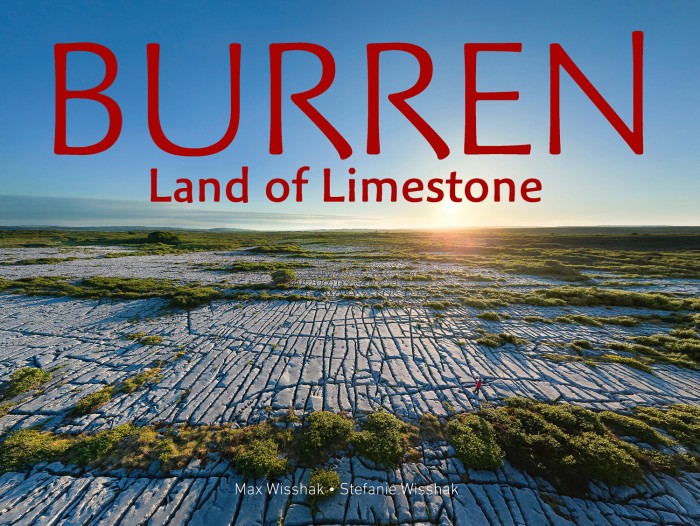
This coffee-table book showcases the captivating charm of an Irish karst landscape. In the Burren, limestone plays many roles, providing a unifying theme as we explore the area’s natural and cultural history, above and below ground.
On the windswept Atlantic coast of Ireland lies an intriguing landscape defined by sparse vegetation on bare limestone rock, smoothed by ice and sculpted by rain. This is the Burren, the heart of the Burren and Cliffs of Moher UNESCO Global Geopark. Its extraordinary glaciokarst terrain is home to an astonishing variety of plant and animal life, not to mention a rich geological and cultural heritage – all of which revolve around the limestone.
This book traces how rainwater shapes limestone pavements, how underground streams carve out caves that feed holy wells and ephemeral lakes, and how bare rock provides microclimates for archaic ferns and colourful orchids. It goes on to illuminate how communities used the stone beneath their feet to build megalithic tombs, cashels, tower houses, churches, and the vast network of drystone walls that climb the hills and support traditional farming practices in response to the harsh environment. Here, culture did not overwrite geology: it adapted to it.
Join us on a visual journey of discovery as we explore the Burren in all its facets, revealing the compelling beauty of this Land of Limestone.
Contents: Thirst in the Burren (poem) / Land of Limestone / Limestone Pavements / Wild Orchids / Archaic Fern / Sinkholes and Potholes / Caves and Underground Streams / Springs and Holy Wells / Loughs and Turloughs / Drystone Walls / Megalithic Tombs / Cashels and Castles / Churches and Graveyards / Behind the Scenes / Bibliography
Opening Poem: Moya Cannon
Author Bios:
Max Wisshak is a geoscientist in the field of marine research at the Senckenberg institute in Wilhelmshaven, Germany, and has published dozens of scientific articles and book contributions on this subject matter. Hi is also a passionate cave explorer, cave photographer, and publisher, who runs his own publishing label speleo-photo editions. Burren: Land of Limestone (2026) is his fourth premium coffee-table book on the subjects of and caves and karst, following Inside Mother Earth (2008), New Zealand Karst (2020), and Lechuguilla Cave (2022). His wife and coauthor Stefanie Wisshak is a geographer working as free-lance designer, writer, and text editor.
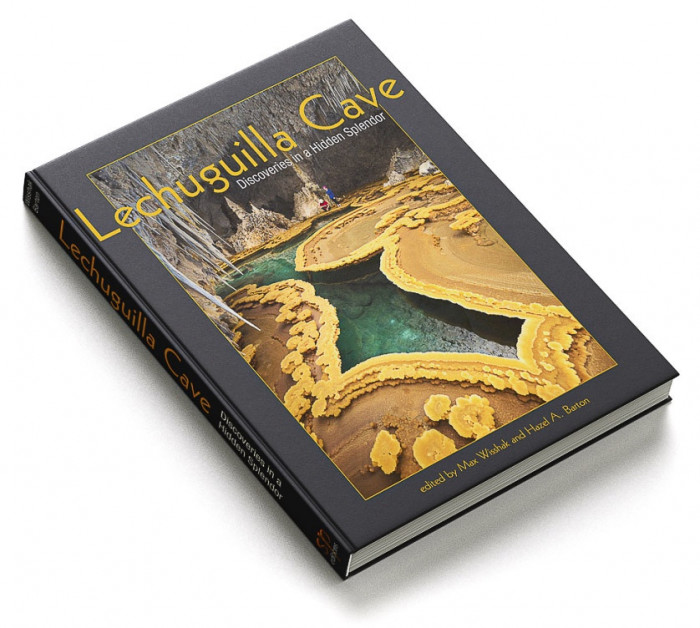
Lechuguilla Cave ( New Mexico, USA) is one of the most beautiful caves on Earth. Since its discovery in 1986, more than 240 kilometers of cave has been explored – with no end in sight. Owing to its geologic setting and unusual process of formation, the cave contains a remarkable diversity of rare minerals and formations, which have helped change our understanding of how caves form and the microbial life they can contain.
In this book, the most active explorers of the cave show the features that made it famous and reveal new discoveries in terms of beauty, scale, and science. Through their writing and photography, they take the reader on their journey of preparing for, and exploring, this remarkable cave. They describe how to successfully live and work in the underground, and highlight the challenges that must be overcome to discover and map new passages. An explanation of how the stunning imagery is captured takes the reader along in this visual journey of Discoveries in a Hidden Splendor. Finally, the extraordinary lengths undertaken to conserve Lechuguilla are illustrated, and how such efforts go hand-in-hand with exploration and photography to reveal the intriguing nature of this wonder of the underground.
Contents:Hidden Splendor (opening statement) / Fragile Beauty (foreword) / Greatness (foreword) / Beginnings (introduction and editors’ preface) / Discoveries / Speleogenesis / Speleothems / Water / Hidden Life / Preparation / Camp Life / Exploration / Mapping Mazes / Photographing Darkness / Rescue / Conservation / Best of the Best (closing remarks) / Fact Sheet / Bibliography / Contributors
Editors:Max Wisshak and Hazel A. Barton
Forewords and Afterword:Jonathan B. Jarvis, Rodney D. Horrocks, Peter Bosted, and Dale L. Pate
Text:Stan Allison, Andy Armstrong, Bonny Armstrong, Hazel A. Barton, Catherine H. Borer, Peter Bosted, Derek C. Bristol, Paul A. Burger, Beth Cortright, Jennifer Foote, Arthur J. Fortini, Donald G. Davis, Kevin Downey, Harvey R. DuChene, James F. Hunter, Daniel S. Jones, John T. M. Lyles, Aria A. Mildice, Arthur N. Palmer, Patricia E. Seiser, Jake Turin, Doug Warner, and Max Wisshak
Photos:Andy Armstrong, Bonny Armstrong, Daniel C. Austin, Hazel A. Barton, Peter Bosted, Derek C. Bristol, Dave E. Bunnell, Daniel Chailloux, Stephen Eginoire, Jennifer Foote, Kevin Downey, Rodolfo González, James F. Hunter, Brian K. Kendrick, Jean Krejca, John T. M. Lyles, Michel Renda, Robbie Shone, Rainer Straub, and Max Wisshak