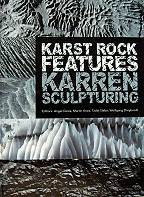
Hardback, 561 pages. Rock features are important traces of the formation and development of karst surface. On various karren their record is especially rich, revealing to us the many factors that in diverse conditions formed the karst surface on various carbonate and other rock.
We have tried to present the most characteristic rock features and through them the most important factors and processes in the formation of the karst surface, the methods of studying them, and the most outstanding examples.
Forty-nine contributing authors offer a wide spectrum of content and examples of rock forms from many karst regions around the world.
The first part of the book offers an orderly-organized survey and description of the most characteristic rock forms and presents the physical and chemical corrosion of rock, biocorrosion, the modeling of rock forms, their detailed morphometrics, and numerous descriptions of individual rock forms. The second part is devoted to various examples of rock forms found around the world from Slovenia through North and South America to Australia and Asia. Edited by: Angel Ginés, Martin Knez, Tadej Slabe, Wolfgang Dreybrodt, 2009. Hardback, 20,5×27,5 cm, 561 pages.
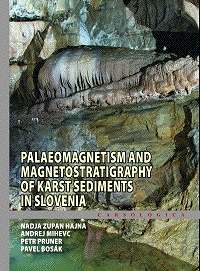
The aim of this book is to set out the results of common Slovene-Czech researches during10 years when karst superficial and cave sediments grouped according to age and depositional environment in various geographical and geological regions of Slovenia were intensively researched mostly by different palaeomagnetic methods. Palaeomagnetic sediment researches have brought surprising results related to the age of sediments both on the surface and underground and consequently also the first detailed information about the age of caves and indirectly the age of our karst. By comparing these data the time of sedimentation is obtained. At sampling the sediments for palaeomagnetic analyses we found in some cases the fossil remains of fauna; these findings are very important as they allow setting out the palaeomagnetic and magnetostratigraphic analyses into precisely defined time.
The introductory part describes the problem of cave sediments dating and their importance at explaining speleogenesis and karst genesis. This part is followed by a detailed presentation of the bases of palaeomagnetic method and magnetostratigraphy in particular related to way of sampling loose sediments and flowstone. In the flowstone the magnetic record is very weak as it contains a tiny bit of iron only; the devices in the laboratory were adapted to measure weak magnetization.
A large part follows containing 21 locations, 19 in Slovenia and two on the other side of the border in Italian Karst where various sediments were analyzed by palaeomagnetic methods. Each location is placed in space describing geological, karstological and speleological properties. A precise description of studied sediment profile with lithological and mineralogical composition follows obtained by various research methods. Every profile contains also the palaeomagnetic results with magnetostratigraphic and palaeomagnetic properties. There, where fossils were found they are paleontologically defined. The description of results is followed by interpretation and discussion about the age of sediments.
An important part of this book treats the significance of performed researches for the development of the dating method. Palaeomagnetic dating method is comparative, meaning that for definition of absolute sediment age we need additional data provided by other methods. The problems occurring when analyzing the sediments in karst caves due to their specificity are described as well as technical solutions of problems. A survey of achieved dating is added as well as their importance to understand the development of caves and karst in Slovenia, for development of surface and for time definition of known tectonic events.
The book is interesting for scientists and experts dealing with karstology, speleology, quartarology, paleontology, geomorphology and geophysics who are engaged in palaeomagnetic dating methods and magnetostratigraphy. This book offers new comprehension from all the mentioned research topics important both for Slovenia (understanding of its geological history, surface development and age of karst) and the international scientific sphere; with the concrete results the book is an important contribution to the science of karstology, geology, geophysics and structural geology. 2008, Nadja Zupan Hajan, Andrej Mihevc, Petr Pruner, Pavel Bosák. Paperback • 20×27 cm • 268 pages • 282 pictures and 81 plate.
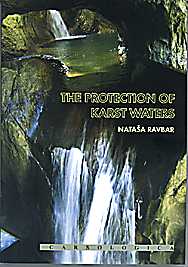
Drinking water is a vital need but nevertheless it is not available to everybody neither by quantity nor quality. Karst aquifers hold important water resources, but are also very sensitive against the pollution. Therefore the passive and active protection is increasingly important, among these the education of inhabitants as well as new and better technical solutions have to be evolved.
The work of Nataša Ravbar is important from both points of view. Results of the inquiry related to the attitude of the local people towards water show its stage in the karst regions of Slovenia. On the other side the concept of groundwater vulnerability is increasingly used for karst water protection worldwide. Based upon a detailed review of different methods used or even obligatory in Europe, the author proposes a new methodology of groundwater vulnerability and risk mapping for the protection of karst sources – the Slovene Approach.
The Approach has been successfully applied and verified in the catchment of the karst spring Podstenjšek at the foot of the Sneznik mountain (Southern Slovenia). A wide range of different geomorphological and hydrological methods and techniques, including monitoring of the karst spring, hydrochemical analyses, tracing of underground water and geophysical survey have been applied. Hence, a better understanding of the regional hydrogeology has been achieved.
The monograph is useful for practitioners and decision-makers dealing with the protection and management of karst groundwater resources, and for scientists doing research on karst hydrogeology and vulnerability mapping. It is a valuable source of information and inspiration for further works dealing with karst groundwater protection in Slovenia and elsewhere. By Natasa Ravbar, 2007, paperback • 17×24 cm • 256 pages • 138 pictures and plate.
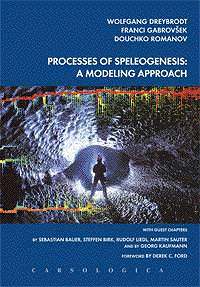
This book draws together the major recent advances in the modeling of karst systems. Based on the dissolution kinetics of limestone, and flow and transport processes in its fractures, it presents a hierarchy of cave genetic situations that range from the enlargement of a single fracture to the evolution of cavernous drainage patterns in confined and unconfined karst aquifers. These results are also applied to the evolution of leakage below dam sites in karst. The book offers a wealth of information that help to understand the development of cave systems. It addresses geologists, hydrologists, geomorphologists, and geographers. It is also of interest to all scientists and engineers who have responsibilities for groundwater exploration and management in karst terrains. A CD including all figures figures from the nook and numerous animations presenting the results is enclosed. Paperback o 17x24 cm o 376 pages o CD-ROM o 250 pictures and 8 plates. By Wolfgang Dreybrodt, Franci Gabrovsek, Douchko Romanov.
The main topic of this monograph is the weathering of carbonate rocks on the walls of cave passages. Of particular interest were the characteristics and peculiarities of the limestone and dolomite weathering processes, the type of solution and why all of the carbonate rock does not dissolve immediately. The results of incomplete solution of carbonate rock are weathered zones that remain on the cave passage walls. The most are weathered cave passage walls soaked by percolation water at the contact with sediments and walls exposed to condensation corrosion. On cave passage walls strongly weathered limestone and dolomite remain only where they are protected from further dissolution and mechanical erosion. During weathering the rock gradually discolours and by increased porosity looses its mechanical strength. Mineral and chemical composition of the weathered zone is almost identical to composition of parent rock, yet it is much more porous. Soluble remain of the incomplete limestone solution is opposed to general theories of karst origin as they accepted the opinion that limestone dissolves if affected by aggressive solution. In described cases an incomplete dissolution may just prepare the carbonate rock for the mechanical transport of its weathered particles by the flowing water. The transported carbonate particles of silt or clay size may accumulate in the cave passages as clastic cave sediments. In any case the speed of water flow must correspond to the rate of weathering in order to tear exposed particles from the rock surface. 2003, 154 pp., 133 color and b/w photos, 170 x 240 mm, paperbound.
The book brings the analysis of relations between recharge and discharge of karst aquifers, i.e. input and output functions of karst system, which can be applied in order to define the characteristics of its functioning. Three different recharge-discharge models were set up. The functioning within the system was expressed by the transfer function between the input and the output signal, and the adequacy of individual models was evaluated according to the accuracy of the simulation, which is related to the transfer function's ability to reproduce discharges, on the basis of which it was determined. The improvement in the model's results, brought about by the introduction of the effective infiltration function instead of the precipitation, highlighted the significant influence exerted by the vegetation and processes in air and in the soil on the quantity and the temporal distribution of actually infiltrated water. Additionally, a specific hydrodynamic function of epikarst was proved, which, due to its typical structure, influences the temporal distribution of recharge. By Metka Petric, 2002. Paperback, 17x24 cm, 154 pages.
The book presents the application of numerical modelling in study of early speleogenesis. First part discusses the evolution of a single fracture in various hydrological, geochemical and geological settings. Numerical results are compared to more general, analytical results. Understanding the evolution of a single fracture, serves as a basic block for the interpretation of more complex models, such as the models of confined and unconfined two dimensional fracture networks. These models are described in the second part of the book. The results support some of the conceptual speleogenetic models, and suggest new mechanisms which might be active in early speleogenesi. By Franci Gabrovsek, 2000, 17x24 cm, 150 pages
Radiation, radioactivity, radon: these are words that, since Hiroshima, the Cold War and Three Mile Island, have conjured fear and fascination for many Americans. The danger of radon - a colourless, odourless gas that could seemingly strike any home and afflict its residents with cancer, was brought home in the 1980s when whole neighbourhoods were deemed unsafe due to a perceived threat from radon. But how much of a threat does radon really pose? Is the government's aggressive policy warranted. Indeed, is their a legitimate threat at all? These are the questios Leonard A. Code asks in this provocative and fascinating new book, and his answers are ones that all homeowners will want to understand. In clear, non-technical language, Code dispells many of the myths surrounding radon as he makes recommendations for a coherent reasonable environmental policy towards what is, certainly, a dangerous gas. As he carefully traces the development of the US indoor radon policy, Code illuminates the many scientific uncertainties that lie behind it, exposes the policies of those who stand to gain from radon policy decisions made in Washington, and challenges the EPA's risk-cost assessment of radon levels. Thoughtful and timely, ELEMENT OF RISK illuminates one of the most important public policyissues of our time.
A search for evidence of man's antiquity in the caverns of Central America. Being an account of the Corwith expedition of the Department of archaeology and palaeontology of the University of Pennsylvania / by Henry C. Mercer. 1975 HB reprint of the original 1896 edition.
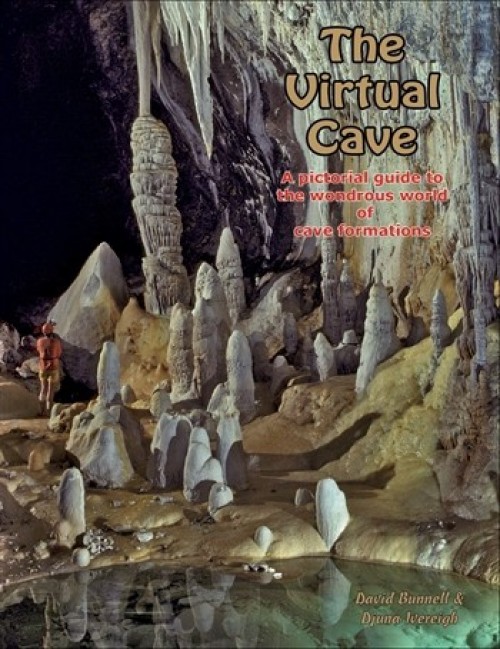
Based on a popular website, this book illustrates, with 580 color photos, 46 different types of formations found in caves, from the most common to some rather uncommon. Basic text explanations are complimented by images of some of the world's most stunning examples of those formations.
Dave Bunnell, a widely published cave photographer, draws on over 40 years of images from caves in some 25 states and 18 countries. Some of the world's most pristine and decorated caves provided source material for the book, such as Lechuguilla Cave in New Mexico, the blue and green caves of France, and the giant caves of Laos and Vietnam with their massive formations.
With this book you will be able to understand how the features found in caves are formed and how they relate to each other. Introductory sections focus on the diverse and often spectacular surface phenomena associated with caves known as karst, and on different types of caves and how the form.
Third Edition, Revised and Updated. By Chet Raymo and Maureen E. Raymo. Imagine yourself standing on the bank of the Connecticut River near Hartford, Connecticut. The river flows placidly through green-mantled hills to the sea. The air is scented by flowering plants, and grasses weave and wave on the shore. Deer graze at the water's edge; birds sing. In the distance are the skyscrapers of the city, the airport and highways, and the sprawling suburbs, all energized by human activity.
Now imagine yourself standing on the same piece of land 200 million years ago. Tall mountains cast long shadows across a bleak desert valley. Volcanoes spew noxious gases into the air, and rivers of lava burst from the rent earth. The land shakes. Dinosaurs cease their feeding and fearfully test the air. More remarkably, the piece of crust on which you stand is much nearer the Earth's equator, 1,000 miles south of where it is today.
In vivid, non-technical prose, Written in Stone traces the geological changes in the American northeast since the continent perched on the equator and dinosaurs were young. Grand events unfold as continents collide, oceans disappear, mountain ranges rise and fall, and mass extinctions decimate entire species. The events are grand, but the features of the landscape created by these events are as familiar as the hill behind your home, the rocks in the stone walls that enclose your yard, and the grains of sand on the beach where you go to swim. The history of the landscape is written in all the rocks and stones of the Northeast. This is an indispensable reference to an understanding of the forces that shaped our familiar landscape from Maine to New Jersey. 6" x 9", paper, 176 ppg., illustrated.
240 PP. Hard bound. A true-life scientific adventure story, this thrilling book takes the reader deep into South African caves to discover fossil remains that compel a monumental reframing of the human family tree.
In the summer of 2022, Lee Berger lost 50 pounds in order to wriggle though impossibly small openings in the Rising Star cave complex in South Africa--spaces where his team has been unearthing the remains of Homo naledi, a proto-human likely to have coexisted with Homo sapiens some 250,000 years ago.
The lead researcher on the site, still Berger had never made his way into the dark, cramped, dangerous underground spaces where many of the naledi fossils had been found. Now he was ready to do so. Once inside the cave, Berger made shocking new discoveries that expand our understanding of this early hominid--discoveries that stand to alter our fundamental understanding of what makes us human. So what does it all mean?
Join Berger on the adventure of a lifetime as he explores the Rising Star cave system and begins the complicated process of explaining these extraordinary finds--finds that force a rethinking of human evolution, and discoveries that Berger calls "the Rosetta stone of the human mind."
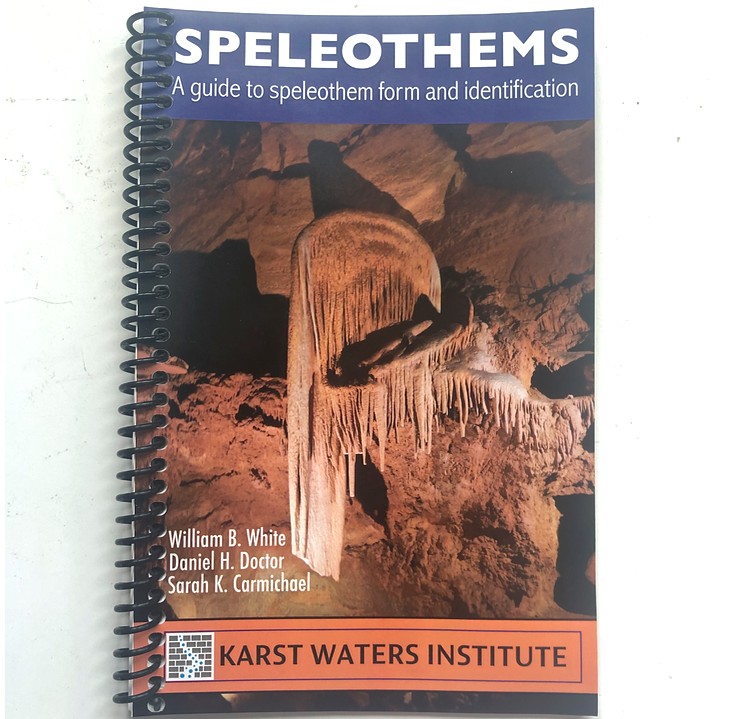
2024. From Karst Waters Institute. By William B White, Daniel H Doctor and Srah K Carmichael. 38 pp.
INTRODUCING THE ULTIMATE FIELD GUIDE TO SPELEOTHEMS from the scientists of Karst Waters Institute.
Almost anyone who ever took a cave tour learned the difference between stalactites and stalagmites, but can you tell anthodites from helictites? Moon milk from pool fingers? Bacon from boxwork? Just as illustrated guides help visitors identify flora and fauna of the surface world, Speleothems: A guide to speleothem form and identification provides cave visitors with descriptions and images of over thirty types of natural mineral deposits found in caves. Written by the cave scientists William B. White, Daniel H. Doctor, and Sarah K. Carmichael, this new publication of Karst Waters Institute describes not only the appearance and names of various speleothems, but the chemical (and sometimes biological) processes that create them. It is perfect for your next cave visit. While commonly called "formations" on cave tours, the term "speleothem" was invented in 1952 to distinguish cave deposits from geological strata which are also called "formations." Readers will learn to classify a wide variety of speleothems by appearance, method of formation, and common geographic locations. Speleothems also provides sources for additional information as well as instruction on how to protect and preserve these rare and delicate cave features. Budding geologists and curious visitors alike will gain deeper understanding of the magnificent world below in this beautifully illustrated and informative handbook.
MEET THE AUTHORS
William B. White William B. "Will" White, a member of the KWI Board since the its formation, has published more than 400 papers on cave and karst research. He is a fellow of the AAAS, the Mineralogical Society of America, and the NSS and spent 40 years teaching geology on the Penn State faculty. Daniel H. Doctor Dan Doctor is a research geologist with the U.S. Geological Survey specializing in karst. His research interests include the hydrology and geochemistry of karst aquifers, assessment of sinkhole hazards, evolution of Appalachian karst landscapes, and paleoclimate records from karst areas. Sarah K. Carmichael Dr. Sarah Carmichael studies "tiny minerals that tell big stories" as a professor of Fluid-Rock Geochemistry and Biomineralogy at Appalachian State University. She became a National Geographic Explorer in 2018 and in 2022 was named one of the Explorers Club 50--fifty people changing the world.
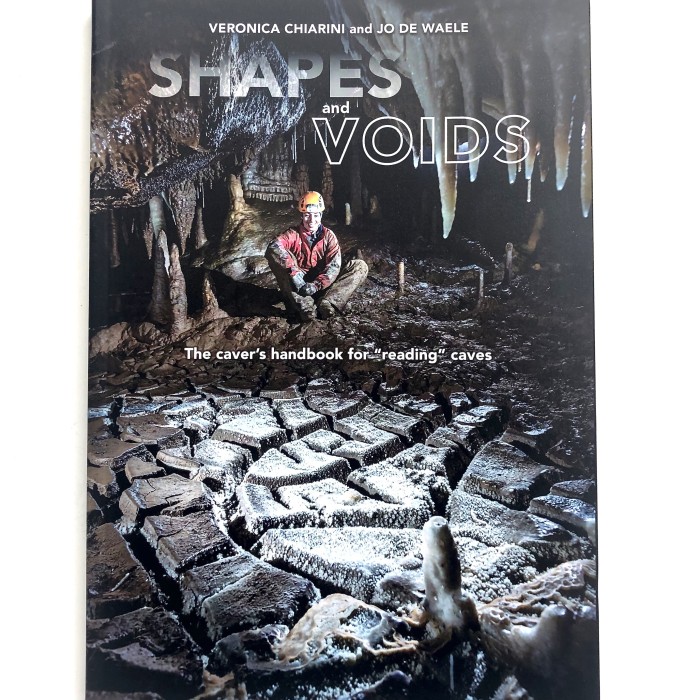
By by Veronica Chiarini and Jo De Waele, with illustrations by Veronica Chiarini. This 135-pages book, printed in color and in English, is dedicated to the geology of caves accompanied by photographs of more than 40 international cave photographers and original illustrations. It is a small manual that aims to guide the reader in observing caves with a different eye, through pictures, drawings, captions and short stories.
The guide tells us that caves and their infillings are like "pages torn from a book", and that a fantastic story can be hidden behind every detail. The targets of the volume are everyone interested in the geology of caves, from speleologists, to scientists and students. The text is revelatory but scientifically correct and updated at the latest frontiers of karstological research.
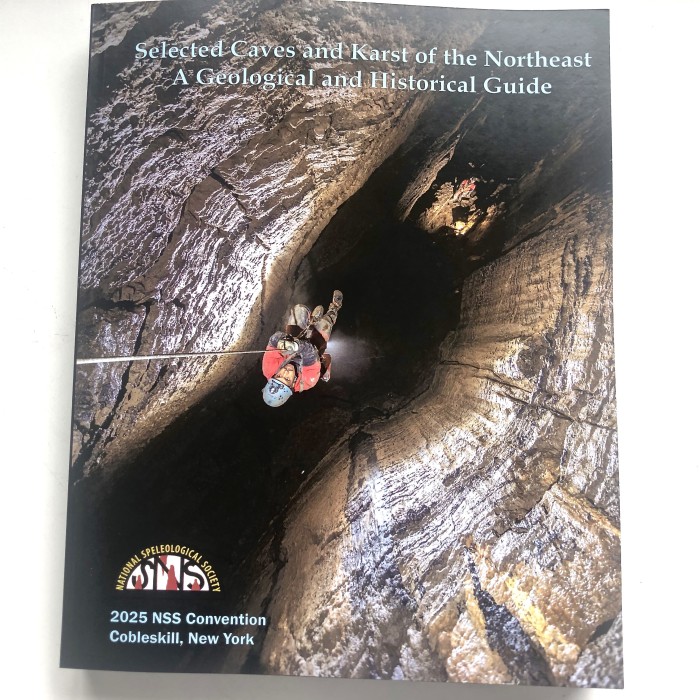
Primary authors John Dunham and Thom Engel. Editing and layout John Dunham. This spectacular 335 page once in a generation treatment of the caves in the Northeast is a monumental accomplishment. The well organized, extensive speleological, historical, and geological guide will serve as the comprehensive, authoratative guide to caves and karst in the northeast for years and years to come. As a bonus (as if any were needed!) the book includes detailed field trip guides for both of the NSS convention Sunday geo trips. A must have publication. This was a short print run with the majority being sold at convention to attendees. In our opinion this book will stand as one of the finest convention guidebooks every published.